
From February 15, online platforms in Vietnam will no longer be allowed to force viewers to watch video advertisements for more than 5 seconds before they can be skipped. With the introduction of this limit, audiences are no longer required to endure lengthy ads before accessing content.
At first glance, the change may appear purely regulatory. In fact, it signals a far more fundamental shift in how communications work, one that redefines the relationship between brands, platforms, and audiences.
The Context
The change is set out in Decree 342/2025, recently issued by the Government, detailing provisions of the Advertising Law specific to digital advertising.
The regulation effectively bans so-called non-skippable video ads that currently run from 7 to 30 seconds on certain platforms, depending on ad formats and devices. Ads that appear unexpectedly and cover all or part of the screen must now include a clearly identifiable close button, must not use fake or misleading icons, and must be dismissible with a single tap or click.
In addition, online ads are required to display visible icons and instructions allowing users to report illegal content, as well as choose to refuse, close, or stop viewing inappropriate ads.
The objective is straightforward: protect user experience and reduce intrusive advertising. The implications go far beyond user interface, indicating Vietnam’s shift toward audience-centric digital environments.
The End of Forced Attention
For a long time, digital advertising relied on forced exposure. Non-skippable ads and mandatory viewing times were widely accepted as the trade-off for free digital content. That model is now formally coming to an end in Vietnam.
The change marks a shift from interruption-based advertising to permission-based exposure. Viewers are given control from the first moment, deciding whether an ad deserves their time. As a result, effectiveness can no longer be driven by locking audiences in. Every second, particularly the first 5, must justify its presence through relevance and clarity.
More importantly, the policy redistributes power. Where platforms and advertisers once dictated viewing time, audiences now determine what is worth watching. The regulation reflects broader global behavior: users increasingly expect control, transparency, and relevance in digital experiences. By formalizing these expectations, the regulation reinforces that attention is no longer assumed, but earned.
How to Win in This New Reality
A 5-second limit may feel restrictive to brands. And in many ways, it is. But constraints often sharpen strategy and creativity. When time is scarce and attention is optional, brands are forced to clarify what truly matters, resulting in more focused, distinctive, and memorable work.

The First Frame Is Now the Most Valuable Placement
The opening moment determines whether an ad is seen or skipped. What appears in the first second now carries more value than everything that follows. If relevance is not established immediately, audiences will not stay long enough for the message to land.
This makes the first frame the most critical media placement. Brand cues, visual identity, and a clear point of interest must appear upfront, not as a delayed reveal. Ads are no longer rewarded for gradual build-up, but for instant recognition.
→ Takeaway: Design for the opening, not the ending.
Storytelling Evolves into Story Triggering
Skippable formats challenge traditional storytelling structures. Brands can no longer rely on complete narratives unfolding over time, as audiences may never reach the conclusion.
Instead, storytelling becomes about creating an entry point, something that sparks curiosity, emotion, or recognition within seconds. The purpose is not to tell the whole story, but to invite audiences to continue engaging beyond the ad itself.
→ Takeaway: The goal is not completion, but continuation.
Performance Marketing Cannot Ignore Brand Building
Short-form and performance-driven ads still depend on brand strength to work efficiently. Without clear brand signals, ads may generate short-term responses but fail to build recognition or long-term value.
In this 5-second environment, strong brand codes allow even brief exposures to contribute to memory and efficiency over time. When brand presence is weak, performance becomes more expensive and less sustainable.
→ Takeaway: Performance without brand recognition wastes budget.
Audience-Centricity Is Not That New
Audience-centric thinking has never been a breakthrough idea. Brands have talked about it for years. What this new regulation does is remove any remaining ambiguity: communication only works when audiences choose to engage.
By turning user control into a legal requirement, the rule confirms this long-standing truth. Attention cannot be demanded, engineered, or prolonged by force. It must be respected. This applies far beyond advertising, shaping how brands approach content, social, PR, and every touchpoint in between.
→ Takeaway: Audience-centricity always wins.
Restricted Ads Open the Door to Broader Communications Thinking
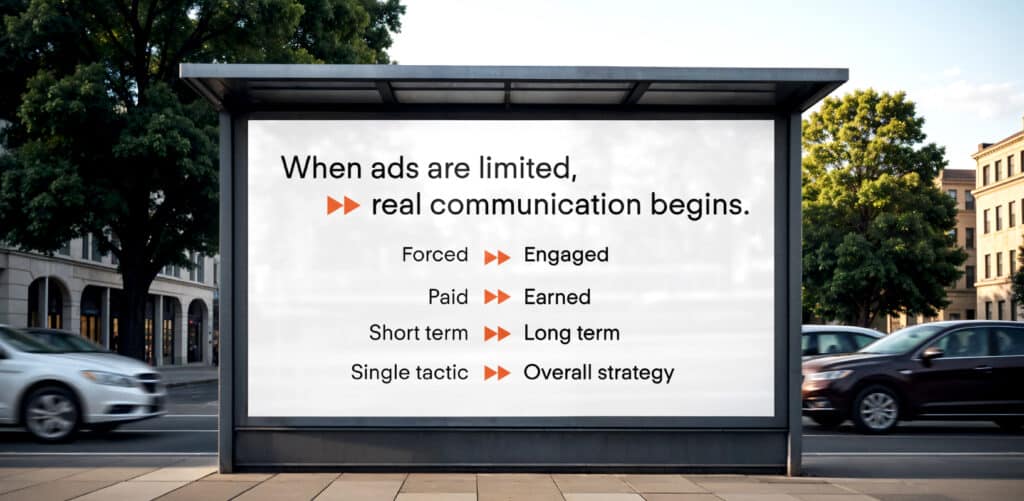
As video advertising becomes more constrained, the opportunity is not only to adapt formats, but to rethink the role of paid attention altogether. When audiences can skip with ease, brands are reminded that not all attention needs to be bought. Earned credibility, visibility, and presence, built through public relations, partnerships, and community, become more valuable over time.
This shift also rebalances the media mix. Channels that cannot be skipped, such as OOH, gain renewed strategic relevance. More importantly, it encourages brands to invest in long-term brand foundations: clear narratives, strong reputation, and consistent presence across touchpoints.
The Conclusion
The regulation rewards strong brands, not big spenders. Brands with clear identities and strategic discipline will adapt far more effectively than those relying on media pressure to secure attention.
More importantly, respectful advertising builds long-term brand equity. Giving audiences control does not weaken brand impact, it strengthens trust, relevance, and credibility. In a digital environment where attention is no longer assumed, the brands that earn it will be the ones that endure.
As Vietnam’s communications landscape continues to evolve, we partner with brands to build audience-first strategies, distinctive brand systems, and creative work designed to perform in environments where attention must be chosen.
If your brand is navigating what meaningful communication looks like today, Ivy+Partners is always open to the conversation.